
Georgiy Pavlovich Osipov
Soviet WWII hero. Delivered vital supplies on the Road of Life across Lake Ladoga under constant bombardment.
Chapter I: Pre-War Years and Conscription
Georgiy Pavlovich Osipov was born on , in the picturesque Georgian village of Vejini, in the Gurjaani Municipality. His mother, Natalya Aleksandrovna Osipova, lived in the city of Tbilisi at 37 Sovetskaya Street. Even before the war, Georgiy had mastered the important and in-demand profession of a driver, a skill that would largely define his military destiny.
In the , at the age of 20, he was called up for active military service by the Tbilisi City Military Commissariat. Thus began his army life, which was soon to be shattered by the thunder of the Great Patriotic War.
Chapter II: Baptism by Fire and Service on the Leningrad Front
From , Yefreitor (Corporal) Osipov was a participant in the battles on one of the most brutal fronts of the war—the Leningrad Front. He was assigned as a driver to the motor pool platoon of the 69th Guards Independent Anti-Aircraft Artillery Battalion (OZAD). The battalion’s mission was to protect troops and strategic objectives from enemy air raids. Georgiy’s mission was to ensure the battalion’s mobility: transporting ammunition, provisions, personnel, and artillery pieces.
His award documents note that from the very beginning of the war, he proved himself to be an exemplary driver whose vehicle “knew no breakdowns or accidents under any conditions.” This was critically important in the chaos of the war’s first months, when the lives of hundreds of soldiers depended directly on the speed and reliability of their supply lines.
Chapter III: Heroism on the Road of Life
A special chapter in Georgiy Pavlovich’s biography is his service during the harshest winters of the Siege of Leningrad, from to , on the legendary Road of Life. This ice road across Lake Ladoga was the only artery that supplied the besieged city.
The work of a driver here was a living hell. Under constant German air raids and artillery shelling, in biting frosts, and on fragile ice that could crack at any moment, he drove his GAZ-AA truck. His award citation dryly but powerfully states: “under bombing and artillery fire in the bitter cold, he tirelessly delivered ammunition to the battalion and also ensured the delivery of food supplies.” Family lore holds that his truck broke through the ice more than once due to exploding shells, but he survived and continued to carry out his duty. For this feat of heroism and self-sacrifice, he was awarded the Medal “For the Defence of Leningrad” on .
Chapter IV: Battles on the Karelian Isthmus and the Medal ‘For Courage’
In the , the 69th OZAD, as part of the 23rd Army, participated in the Vyborg Offensive Operation. A key and bloody episode of these battles was the crossing of the Vuoksi River in . Soviet forces were establishing a bridgehead on the enemy bank for a further offensive.
It was here that Georgiy Pavlovich performed the feat for which he was recommended for one of the most honored soldier’s awards—the Medal “For Courage”. In the award citation dated , the battalion commander, Captain Zenov, wrote:
“During the defense of the river crossings over the Vuoksi in , Comrade OSIPOV displayed exemplary courage and valor in delivering ammunition to the bridgehead of our troops across the Vuoksi River. Despite intense shelling of the crossings, the ammunition was delivered on time, which ensured effective fire.”
This act—breaking through under fire to supply the artillerymen on the front line—was crucial to the operation’s success. For this heroism, he was awarded the Medal ‘For Courage’ on .
Chapter V: Post-War Life, Family, and Labor Achievements
After the victory, Georgiy Pavlovich remained in Leningrad, where on , he married Anna Alekseevna Sipina, also a war veteran who had worked in the road maintenance department. Shortly after their wedding, the young couple moved to his homeland, the sunny city of Tbilisi.
In peacetime, he returned to his beloved profession behind the wheel. In , he received a third-class driver’s license, authorizing him to operate various types of vehicles. He worked as selflessly as he had fought, for which he was awarded the badge of a Shock Worker of the Ninth Five-Year Plan.
Family
Georgiy Pavlovich was married to Anna Alekseevna Osipova (born ), a native of the village of Dymi, Leningrad Oblast, who was also a veteran of the Great Patriotic War.
They had three children:
- Bagrat (Borya) Georgiyevich Osipov ( — )
- Irina Georgiyevna Osipova ()
- Diana Georgiyevna Osipova ()
His grandson (through Irina) is David Zurabovich Osipov ().
Chapter VI: Decorations and Honors – A Life of Service Commemorated
The chest of Georgiy Pavlovich Osipov bore testimony to a life of extraordinary courage, dedication, and service to his homeland. His military decorations represent not merely medals, but documented evidence of specific acts of heroism under fire, validated by archival records and eyewitness accounts.
Military Valor Decorations
Medal “For the Defence of Leningrad” (, Serial No. 11443)
This medal, established by the Presidium of the Supreme Soviet on , was awarded to military personnel and civilians who participated in the defense of Leningrad during the 872-day siege. Georgiy Pavlovich’s serial number 11443 places him among the earliest recipients, recognizing his service on the Road of Life where he transported vital supplies across the frozen Lake Ladoga under constant bombardment. The award citation specifically notes his “tireless delivery of ammunition and food supplies under bombing and artillery fire in bitter cold.”
Medal “For Courage” (, Serial No. 1544717)
One of the most prestigious Soviet military decorations for personal bravery, this medal was awarded for his actions during the Vuoksi River crossing in . Captain Zenov’s award citation describes how Georgiy “displayed exemplary courage and valor in delivering ammunition to the bridgehead across the Vuoksi River” under “intense shelling of the crossings.” The ammunition he delivered “ensured effective fire” that contributed to the success of the Vyborg Offensive Operation. This medal could only be awarded for specific documented acts of bravery, making it one of the most respected decorations in the Soviet military system.
Medal “For the Victory over Germany in the Great Patriotic War 1941–1945” ()
Awarded to all military personnel who served in active duty during the war, this decoration confirmed Georgiy Pavlovich’s status as a frontline veteran who served from the first day of the war to Victory Day.
Service Excellence Recognition
This professional distinction was awarded for exemplary driving skills, technical knowledge, and vehicle maintenance. In military logistics, where a single breakdown could mean the difference between success and failure of an operation, this badge represented mastery of a critical combat skill. The award documentation notes that his vehicle “knew no breakdowns or accidents under any conditions” throughout the war.
Post-War Labor Achievements
Badge “Winner of Socialist Emulation” (, for )
This honor recognized outstanding performance in socialist labor competition. In the Soviet system, “socialist emulation” was a structured program for improving productivity and quality. Winners were selected based on quantifiable achievements, making this a meritocratic recognition of his continued dedication to excellence in civilian life.
Shock Worker of the Five-Year Plan ()
Awarded just months before his death, this title recognized workers who consistently exceeded production targets during the 9th Five-Year Plan (1971-1975). For a driver, this meant exceptional reliability, safety record, fuel efficiency, and cargo delivery performance. This was his final official recognition, awarded while he was already gravely ill with the cancer that would take his life eleven months later.
Commemorative Jubilee Medals
Jubilee Medal “In Commemoration of the 250th Anniversary of Leningrad” ()
Awarded to defenders and long-term residents of Leningrad, this medal honored those who maintained connection to the city they had defended. Though Georgiy had relocated to Tbilisi, his service on the Leningrad Front and the Road of Life qualified him for this recognition.
Jubilee Medal “Twenty Years of Victory in the Great Patriotic War 1941–1945” ()
Commemorating the 20th anniversary of Victory Day, this medal was awarded to war veterans, partisan fighters, and home front workers who contributed to the Soviet victory.
Jubilee Medal “In Commemoration of the 100th Anniversary of the Birth of Vladimir Ilyich Lenin” ()
This commemorative medal was awarded to workers who made significant contributions to socialist construction. Its award to Georgiy Pavlovich reflected his dual legacy as both a war hero and a dedicated civilian worker.
Jubilee Medal “Thirty Years of Victory in the Great Patriotic War 1941–1945” ()
His final military decoration, awarded just seven months before his death, commemorated the 30th anniversary of Victory Day. This was the last of the wartime generation’s commemorative medals he would receive.
The Weight of Honor
These ten decorations and badges represent more than metallic symbols. Each was accompanied by archival documentation, award citations signed by commanding officers, and in several cases, specific serial numbers linking Georgiy Pavlovich to official state records. The serial number on his Medal “For the Defence of Leningrad” (11443) can be cross-referenced in the Russian Ministry of Defense archives. His Medal “For Courage” serial number (1544717) corresponds to records in the Podvig Naroda database, which preserves digitized wartime award documents.
Georgiy Pavlovich wore these decorations with quiet dignity, never boasting but never forgetting. They were the visible proof that when his country called, he answered—and when called upon to drive through hell itself, he did not hesitate.
Chapter VII: Final Years and Legacy
Georgiy Pavlovich Osipov passed away on , at the age of 55 from liver cancer. According to his death certificate, he resided in Tbilisi, in the Orkhevi settlement. He was buried in the local Dampalo (Navtlugi Municipal Cemetery), where his grave is marked by a memorial that lists his decorations and service.
He left behind the memory of a humble hero, a brave soldier, and a conscientious worker, whose life serves as an example of courage and devotion to his country. His awards, now preserved in family archives and digitized in state databases, ensure that his acts of heroism will not be forgotten by future generations.

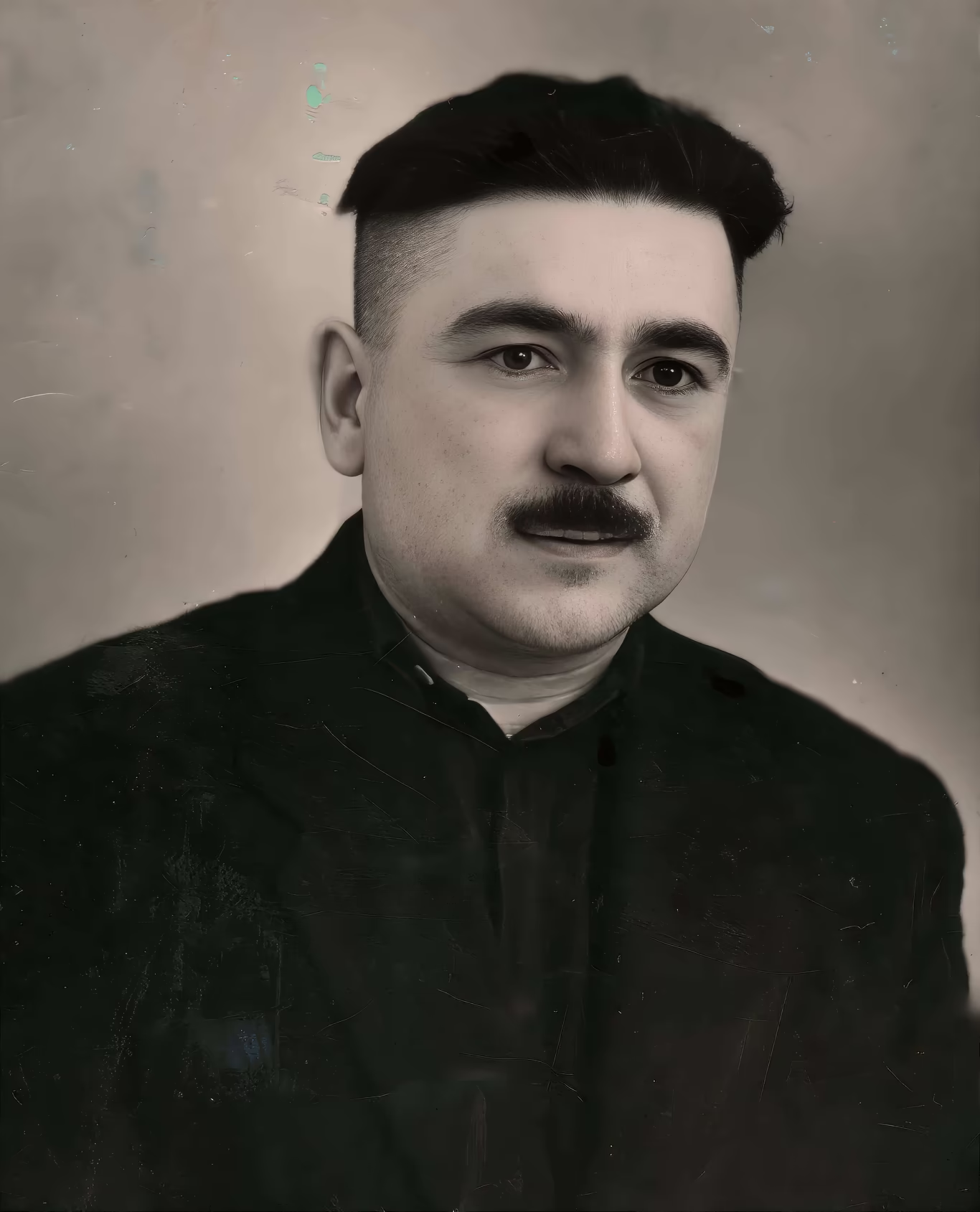
Key Information
- Relation:
- Maternal Grandfather
- Born:
- Died:
- Age:
- 55 years
- Occupation:
- WWII Veteran, Military Driver, Shock Worker of Communist Labor
- Birth Place:
- Vejini village, Gurjaani Municipality, Georgia
- Death Place:
- Orkhevi settlement, Tbilisi, Georgia
Awards & Honors
- 🎖️ Medal "For the Defence of Leningrad" (December 22, 1942, Serial No. 11443)
- 🎖️ Medal "For Courage" (August 19, 1944, Serial No. 1544717)
- 🎖️ Medal "For the Victory over Germany in the Great Patriotic War 1941–1945" (May 9, 1945)
- 🎖️ Excellent Chauffeur Badge (May 15, 1946)
- 🎖️ Jubilee Medal "In Commemoration of the 250th Anniversary of Leningrad" (March 26, 1958)
- 🎖️ Jubilee Medal "Twenty Years of Victory in the Great Patriotic War 1941–1945" (May 7, 1965)
- 🎖️ Jubilee Medal "In Commemoration of the 100th Anniversary of the Birth of Vladimir Ilyich Lenin" (March 25, 1970)
- 🎖️ Badge "Winner of Socialist Emulation" (January 31, 1974, for 1973)
- 🎖️ Jubilee Medal "Thirty Years of Victory in the Great Patriotic War 1941–1945" (April 25, 1975)
- 🎖️ Shock Worker of the Five-Year Plan (January 24, 1975)
Burial Location
- Name:
- Navtlugi Municipal Cemetery (Dampalo) (opens in new tab)
- Address:
- Tbilisi , GE
- Coordinates:
- 41.6948886, 44.8872265 ( Opens in new tab )